
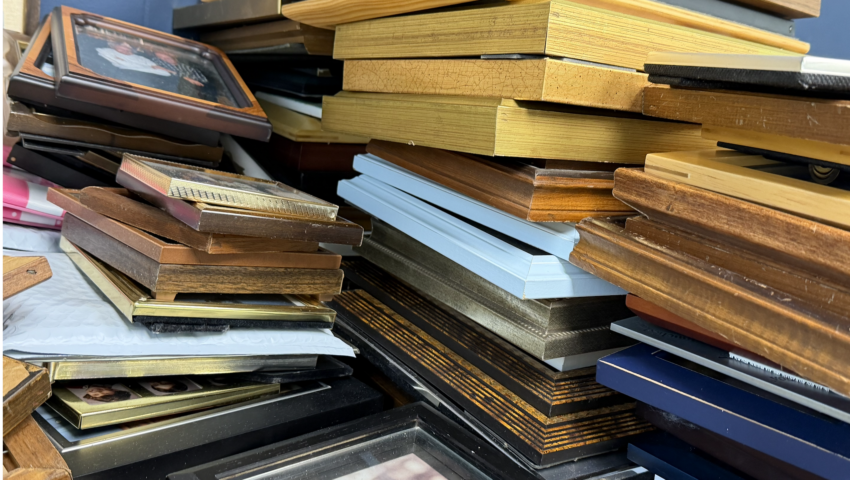
If you’re getting ready to organize your family photos, one of the easiest places to start may be hiding in plain sight: your old photo frames. Frames can be beautiful ways to display the people and memories we love. But when photos are no longer being displayed, those frames can quickly become bulky storage containers—taking up far more space than the photographs themselves.
Recently, we started a large photo-organizing project at Pixologie that arrived in fourteen bins and boxes. About half of those boxes contained framed photographs. There were small frames, large frames, professionally framed portraits, decorative frames, old frames, and frames with those tiny metal pieces that seem determined to keep everything tightly in place.
There were also plenty of dusty, worn frames that had been stored away for years. Because it is one frame at a time… Even when I tackle them all at once.
More Than 110 Frames, Two Hours, and a Lot More Space
In about two hours, I removed photographs from more than 110 frames.
When I was finished, the bulky frames were gone from the storage boxes. What remained were three neat stacks of photographs:
- Portraits
- Older heritage photographs
- Modern family photographs
Just like that, we had reduced the amount of storage clutter by about 50%. The photographs hadn’t disappeared. In fact, they were now much easier to see, sort, and work with.
And that is what makes old frames such an easy place to make progress when you’re beginning to organize your family’s photographs.
Why Framed Photos Can Become a Storage Problem
When a photograph is sitting inside a frame, it’s easy to think of the entire thing as one item. But when you’re organizing your photo collection, the frame and the photograph have very different purposes.
The photograph is part of your family history.
The frame is simply the container or display method.
If the photograph is no longer being displayed, keeping the frame around it may mean you’re using valuable storage space for something you don’t actually need. Over the years, framed photographs can accumulate in closets, attics, basements, garages, storage rooms, and boxes. And because frames are often bulky, they can make a collection look much larger than it really is. Removing the frames can be a surprisingly simple way to create room for the work that actually matters: seeing, organizing, identifying, and preserving your photographs.
Take a Look at the Frames You’ve Packed Away
If you’re ready to make some progress on your photo collection, start by looking at the framed photos you have stored away.
Ask yourself:
Is this photograph currently being displayed?
If the answer is yes, there’s probably no reason to remove it. If you love the way it looks in the frame, keep enjoying it! But if the frame has been sitting in a closet or storage box for years, it may be worth taking the photograph out. Once you’ve carefully removed it, you can add the photograph to your larger photo collection and decide how you want to organize and preserve it.
The frame itself can be evaluated separately.
If you still love the frame Keep it! You may want to use it again for another photograph. If you no longer need it Consider donating it if it’s still in good condition. Someone else may be able to give it a second life. If the frame is damaged If it’s cracked, broken, or no longer useful, you can consider disposing of it appropriately rather than allowing it to continue taking up storage space.
The goal isn’t to get rid of things simply for the sake of decluttering. The goal is to separate your photographs from the things that are making them harder to organize.
Be Careful When Removing Old Photos
Before you start pulling photographs out of frames, take a little care. Older frames can sometimes have fragile glass, rusty metal tabs, or backing materials that have become brittle over time.
Work on a clean, flat surface and handle the photograph by its edges whenever possible. If a photograph appears to be stuck to the glass, backing, or another part of the frame, don’t force it. Trying to pull a stuck photograph away can cause more damage than leaving it alone. In those cases, it’s better to set it aside for professional help. And remember: not every photograph needs to be removed from its original frame immediately. If you’re unsure, leave it intact and come back to it later.
What to Do With the Photos Once They’re Out
This is where removing frames can really help. Instead of having photographs scattered between boxes of framed items, you can begin bringing the photographs together into one collection.
You may discover photographs you haven’t seen in years. You may find duplicates. You may uncover photographs of relatives you don’t immediately recognize. You may even find photographs that you’ve been looking for. Don’t worry about getting everything perfectly organized right away.
Start by creating broad categories.
For example:
- Portraits
Photographs primarily focused on one person or a small group. - Heritage Photos
Older photographs from parents, grandparents, great-grandparents, and earlier generations. - Family Photos
Photographs from birthdays, holidays, vacations, gatherings, and everyday family life.
These don’t have to be your final categories. They’re simply a way to begin making sense of what you have.
One Small Project Can Make a Big Difference
Photo organizing can feel overwhelming because we tend to think about the entire collection at once. Maybe you have years of photographs. Maybe they’re spread across multiple rooms. Maybe they’re in boxes, albums, drawers, closets, and storage bins. You don’t have to organize everything today.
Instead, look for the places where you can make a visible difference quickly. Old framed photos are one of those places. Removing more than 110 photographs from their frames took about two hours in our recent project. The result wasn’t a perfectly organized photo collection but it was a collection that was smaller, more manageable, and easier to work with. Sometimes that’s exactly the kind of progress you need to keep going.
Start With the Frames
Take a walk through your home and look for framed photographs that are no longer being displayed.
Check the closets.
Look inside storage bins.
Look behind furniture.
Look in the garage or other areas where old family belongings have accumulated.
You don’t need to tackle every frame at once.
Choose one box, one shelf, or one small area.
Remove the photographs that are no longer being displayed, place them with your other family photographs, and decide what to do with the empty frames.
You might be surprised by how much space you reclaim.
And perhaps even more importantly, you may be surprised by how good it feels to have those photographs back where you can actually see them, work with them, and preserve them. Sometimes the first step toward saving your family photos is simply getting them out of the frames.
Want to do it yourself—but need a place to work, guidance when you get stuck, and people to keep you moving forward? Join The Pix Plan Community, where you’ll have dedicated time, support, and encouragement to make real progress on your photo projects.
Ready to have someone take the project off your plate?
Our Done-for-You Photo Organizing Services can help you bring order to your print and digital photos, preserve what matters, and create a photo collection your family can actually enjoy.
Not sure which option is right for you? Schedule a meeting with us to talk through your photo project, ask questions, and find the best next step for your collection.
Either way, the goal is the same: get your photos out of the boxes, bins, devices, and digital clutter—and into a photo estate that is organized, protected, and ready for your family.